You are always Alone or.....
"Are you?"
Ever felt it — that sudden stillness in the room when the air just... shifts?
Like something unseen just passed by.
The floor creaks, and for a second, you swear you hear footsteps — though you know no one’s there. And yet, you can’t shake the feeling someone’s watching you, even with the lights on.
Most people laugh it off.
They say it's just the mind playing tricks.
But others... they’re not so sure.
They talk about things older than us — things that drift through walls and whispers, things that never really left. Every culture has a name for them: ghosts, demons, spirits, jinn, shadows.
Stories change, but the feeling stays the same.
“Maybe it isn’t just about ghosts being real or not.”
Maybe hauntings are more about us — about what fear does when it’s left alone in the dark too long. Every legend, every ritual, every flicker in the corner
might be telling a story about the human mind — about the things we hide behind reason.
So before we talk about exorcisms or science or myths, ask yourself this:
"Are you really alone in your home… or is something already here, waiting in the quiet?"
PART 1 — The Truth Behind Ghosts: What Psychology Says About Hauntings?
~A PRESENCE IN THE DARK ~
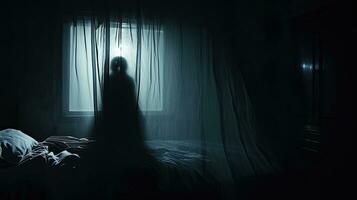
There’s a moment most people have lived — that sudden stillness in a room when something just feels… off. The fan’s spinning fine, the windows are closed, the lights steady, but deep inside, a small voice says the air has changed. It feels like someone invisible has quietly stepped in, standing somewhere you can’t see.
Sometimes it happens right where you feel safest — your own bedroom, that hallway you walk through every day, or the terrace when the wind suddenly stops. Other times, it’s in places that already make you uneasy — quiet hotels, old houses, staircases where silence sounds too loud.
In that instant, your body knows before your mind does.
Heartbeats rise, breathing slows, and your skin tightens like it’s warning you of something you can’t explain.
When I was younger, during those power cuts on hot summer nights in India, I’d stare at my doorway, half expecting something to move. There was nothing there — only darkness — but the longer I looked, the more I could almost see a human ‑ shaped outline forming. And the longer I watched, the harder it was to tell myself it was just imagination.
Was it only fear… or was something really standing there?
Every culture in the world has asked that same question.
The answers change — ghosts, spirits, demons, jinn, ancestors, shadows, energies — but the feeling never does.
Humanity has thousands of languages, but fear speaks only one.
And that’s where this journey begins.
I. WHAT ARE GHOSTS? — A UNIVERSAL IDEA WITH MANY FACES
Ghosts aren’t just monsters or shadows. They’re symbols — reflections of regret, loss, trauma, and the unknown. To really understand what “haunting” means, we first have to see how people everywhere have imagined these beings.
Across the world, the shape of a ghost keeps changing.
But deep down, one thing stays the same:
Ghosts represent what humans don’t understand — what we fear, miss, or fail to let go of.
THE SPIRIT / REVENANT — THE CLASSIC GHOST—
Found almost everywhere in the world.
- The soul of someone who died too suddenly.
- A person with unfinished business.
- Someone attached to a place, an object, or another person.
- A being held back by emotions too heavy to fade away.
In Hindu tradition, the spirit is called *Atma*. When it’s restless, it becomes *bhoot* or *pret* — sometimes because of incomplete rituals or unresolved karma.
In the West, people spoke of “revenants,” the returners — not always violent, but never peaceful.
The message stays the same everywhere:
Human emotions don’t die easily.
THE POLTERGEIST — THE NOISY SPIRIT—
Mostly from Europe and America.
They aren’t quiet watchers — they make their presence known.
Objects fly, walls echo with knocks, electricity flickers, doors slam.
Psychologists noticed something strange: these hauntings often appear in homes with teenagers under stress. Maybe the chaos inside finds a way to burst outward — through the house, through sound, through movement.
That doesn’t make them fake. It makes them something real — shaped from emotion.
DEMONS — THE ANCIENT FORCES—
Found in Christian, Jewish, Islamic, and older pagan stories.
Said to whisper, possess, torment, and twist the human mind.
They represent the oldest fear of all — that something entirely inhuman can crawl into a human life.
Through centuries, that fear shaped exorcisms, prayers, charms, rules — anything to fight back against the dark.
JINN — THE SMOKELESS BEINGS—
In Arabic belief, jinn are not dead humans. They’re creatures made from smokeless fire — powerful, unpredictable, and free ‑ willed like us.
They can be kind, playful, angry, or indifferent.
Stories place them in deserts, wells, ruins, forests, crossroads.
For many, jinn explain strange moods, sudden changes in behavior, nightmares, or feelings of being followed.
These tales blend magic with psychology and faith, making the unseen feel close.
ONRYŌ / YŪREI — JAPAN’S BEAUTIFUL HORRORS—
In Japan, ghosts blend sorrow and grace.
Onryō are vengeful women, pale as paper, dressed in white funeral robes, with long black hair and movements that defy gravity.
Their stories are tragedies of betrayal and injustice — pain transforming into spirit.
Modern Japanese horror didn’t invent them; it simply unwrapped legends as old as memory itself.
THE WHITE LADY — EUROPE’S SAD ECHO—
A figure seen on bridges, forest paths, castle halls — always in white, always alone.
She isn’t evil or monstrous. She’s grief made visible — a woman betrayed, heartbroken, or abandoned.
The White Lady reminds us that not every ghost wants revenge. Some only want to be remembered.
II. GLOBAL URBAN LEGENDS — THE GHOSTS THAT BELONG TO PLACES
Now, stories shift from myth to something local — the whispers passed from one generation to the next.
Every culture has its ghost that feels “close to home.”
Let’s walk through some of them.
INDIA — WHERE MYTH MEETS MEMORY
India may have more ghost stories than most countries combined. They aren’t all dark — some are tragic, playful, or protective.
BHANGARH FORT (Rajasthan) — THE CURSED TOWN—
Even before you cross the gates, the silence feels alive.
People say a magician cursed the fort after his spell to capture a princess failed. The town fell into ruin overnight, and no one was allowed to live there again.
After sunset, the gates are locked. Locals talk of footsteps, whispers, crying voices, and moving shadows.
Whether that’s imagination or something older — Bhangarh still hums with unease.
NAALE BA (Karnataka) — “COME TOMORROW”—
At night, a witch knocks on doors using voices of loved ones.
If you answer, she takes you.
To survive, people wrote “Naale Ba” — “Come tomorrow” — on their doors, tricking her to leave.
It’s a story born from an old fear — hearing someone you trust when you know they shouldn’t be there.
UNITED STATES — MODERN HAUNTINGS
American ghost stories spread like wildfire through films and books — but many began as personal tragedies.
THE CONJURING HOUSE (Rhode Island)—
The Perron family’s 1970s farmhouse became a nightmare of stopped clocks, moving objects, and strange smells. Some called it a haunting. Psychologists saw stress, sleep disorders, and collective suggestion.
Either way, fear made the story unforgettable.
THE AMITYVILLE HOUSE (New York)—
One real murder led to endless stories — demonic voices, cold spots, slime on the walls.
Skeptics call it media hype.
Believers say the blood left something behind.
LATIN AMERICA — THE CRY THAT NEVER FADES
LA LLORONA — THE WEEPING WOMAN—
A woman who drowned her children in grief, now spending eternity crying for them near rivers.
Parents use her legend to warn children from wandering late.
Psychologically, she is guilt, sorrow, and loss given a face.
Shared grief turned into eternal sound.
THE ARABIAN DESERT — HOME OF THE JINN
UMM AL ‑ DUWAIS — THE DESERT TEMPTRESS —
She appears beautiful and gentle, calling to lonely travelers.
But when approached, her face twists into something monstrous — red eyes, fangs, claws, and an echoing voice.
A moral wrapped in a ghost story: don’t chase temptation, don’t disrespect silence, don’t walk alone at night.
FRANCE — GHOSTS OF ELEGANCE AND SORROW
LA DAME BLANCHE — THE WHITE LADY—
She appears on quiet roads, asking for help or simply staring until she fades away.
She is loss, innocence, betrayal — emotion turned into mist.
French stories don’t always scare. Sometimes, they just ache.
PART ONE ENDING — INTO THE HUMAN MIND
We’ve met spirits from every corner of the world, all born from fear and memory. But this is only the surface.
Next comes the question that truly matters:
What happens inside your mind during a haunting?
Are these entities real… or is the human brain far more haunted than any house could ever be?
PART 2 — THE MIND THAT SEES GHOSTS
We like to think of ourselves as logical, but the mind is a labyrinth — especially late at night. Those strange scratches in the walls, whispers in empty corridors, things only you seem to hear: the more you try to reason with them, the more the mind closes ranks, feeding on its own suspicion.
Scientists have spent decades trying to unmask the source of our terror. Some experiments revealed harsh truths.
Take “The Monster Study” — orphaned children subjected to criticism until their voices broke, haunted their whole lives not by spirits, but by suggestion and fear planted by adults.
Or the “Stanford Prison Experiment” — ordinary people turned cruel, feeling watched and threatened by those in charge, their reality warped by authority and expectation.
In these studies, the unseen forces at work weren't spirits, but the human mind itself, twisting and reshaping the world around it.
Yet group terror, too, leaves its scars on history.
The Salem Witch Trials started with girls writhing and shrieking, claiming invisible forces were assaulting them. The panic swept through entire villages, with dozens executed and hundreds accused — all because of fear echoing from mind to mind.
In Malaysia, whole classrooms of girls fainted and screamed, saying they were possessed by spirits, though medical teams found no physical cause.
Over time, names and places change, but the story stays the same: show people a haunted place, and many will see, hear, or feel something. The imagination is not just a passenger — it’s at the wheel.
But the mind’s power isn’t always innocent.
Consider the chilling experiments in sensory deprivation — people locked away from light and sound for hours or days, some soon reporting whispers, footsteps, figures flickering in and out of vision. The brain, starved for input, supplies its own ghosts.
RAW FEAR: THE RUSSIAN SLEEP EXPERIMENT—
Set in the shadowy days of the 1940s, this story claims Soviet scientists locked five men in a sealed room and fed them a strange gas to keep them awake — promising freedom if they lasted thirty days.
At first, things were normal.
But after a week without sleep, the captives grew paranoid — some screamed until their voices snapped, others whispered secrets to invisible figures.
As the days dragged on, events turned gruesome: prisoners clawed at themselves, tore the books and smeared the glass with filth, and hurt each other, becoming shadows of themselves, addicted to the gas that kept them awake.
By the end, only a few were left — barely human, their minds lost to waking nightmares.
There was no demon or curse. Just sleep deprivation and fear, pushed far beyond what most of us can imagine.
Was it real? No — it’s fiction, a modern myth.
But its popularity speaks to something we all sense: that within us lies a breaking point, and perhaps the mind, left alone and wounded, can become the scariest monster of all.
MASS HYSTERIA: WHEN EVERYONE SEES THE GHOST—
Sometimes a haunting isn’t one person’s vision, but a whole community’s.
In the 1980s, over 300 people — mostly kids — at a UK event suddenly fainted and vomited. There was no poison, just shared anxiety and panic, spreading faster than any toxin.
The infamous “Hammersmith Ghost” panic in England led to nighttime watches and even a shooting — all over a figure that may never have existed.
In Japan and Korea, thousands of people have fainted or become sick after a rumor of a curse or ghost spread through schools or workplaces — a dance of rumor, fear, and the need for explanation.
AND THEN... THE TRICKS OF THE ENVIRONMENT
The mind sees what it expects.
Tell someone a room is haunted, and they’ll jump at every creak and cold spot.
Scientists have found that certain frequencies we can’t even hear (like 19 Hz infrasound) may make our eyeballs vibrate, causing strange shapes at the edge of vision. Strong electromagnetic fields, sometimes found in old electrical systems, can nudge the brain to “feel watched” or spark mild hallucinations.
When mental suggestion, group fear, and physical triggers all work together, the result can look — and feel — exactly like a classic haunting.
SO, WHAT DO WE TAKE AWAY?
Not every ghost story is just “in your head.”
Sometimes, it’s “in your mind, your body, your community — and your past, all layered together.”
Sometimes, it’s one person’s secret fear.
Sometimes, it’s madness let loose in a crowd.
And sometimes, it’s what happens when we peer too long into the dark... and see something staring right back.
Hauntings, whether spiritual or psychological, remind us:
The closest ghost is sometimes the one living inside us — waiting to appear when we are weakest, loneliest, or most afraid.
ARE ALL GHOSTS BAD? — A UNIVERSAL IDEA WITH MANY FACES
Across the world, the shape of a ghost keeps changing.But deep down, one thing stays the same:
Ghosts represent what humans don’t understand—what we fear, miss, or fail to let go of.
THE SPIRIT / REVENANT — THE CLASSIC GHOST—
Found almost everywhere in the world.
The soul of someone who died too suddenly.
A person with unfinished business.
Someone attached to a place, an object, or another person.
A being held back by emotions too heavy to fade away.
In Hindu tradition, the spirit is called Atma. When it’s restless, it becomes bhoot or pret—sometimes because of incomplete rituals or unresolved karma.
In the West, people spoke of “revenants,” the returners—not always violent, but never truly at rest.
GOOD GHOSTS — GUARDIANS, MESSENGERS, AND FRIENDLY SPIRITS—
Not every ghost is here to harm the living. Many cultures believe in spirits who protect, warn, or comfort.
Japanese Zashiki-warashi
In rural Japan, families speak of zashiki-warashi—childlike house spirits said to bring good luck, prosperity, and playfulness. Their presence is often celebrated; it’s bad luck if they leave.
In Chinese tradition, the spirits of ancestors are honored annually during festivals. They are believed to watch over loved ones, guide families, and bring blessings—so long as they are remembered and respected.
The Friendly Lady in White
In parts of Europe, some “White Lady” legends describe ghosts who protect travelers from danger or appear before disasters, offering silent warnings.
While the churel is usually feared, some stories show her protecting women or punishing only those who hurt others, blurring the line between vengeful and just.
Here, the message is simple:
Not all who linger do so out of anger—some stay to care.
BAD GHOSTS — HAUNTERS, CURSES, AND VENGEANCE—
Other spirits are deeply feared—ghosts driven by rage, injustice, or sorrow.
La Llorona (Latin America)
A mother’s spirit doomed to roam rivers, crying for the children she lost. She’s said to snatch wandering children by the water’s edge, a warning born from tragedy.
Poltergeists (Europe and America)
Noisy, chaotic, and sometimes violent—these spirits are known for moving objects, slamming doors, or scratching walls. Many poltergeist stories begin with teenage turmoil or unresolved pain.
Egyptian Afarit and Arab Jinn
Sometimes cruel or vengeful, these spirits or entities are blamed for misfortune, madness, or sudden storms. There are stories of travelers lost in the desert, tricked by jinn with shifting forms.
In Karnataka, the legend of a witch who calls out in the voice of a loved one at night terrified entire villages. Only by writing “Naale Ba” (“Come Tomorrow”) could families keep her away.
In these tales, ghosts are warnings—reminders of wrongs not righted, debts unpaid, words never spoken.
IN BETWEEN — NOT ALL GHOSTS FIT THE MOLD
Some spirits blur the lines between good and bad.
They protect—unless ignored. Comfort—unless disrespected. Haunt—unless rituals are done right.
In these stories, ghosts aren’t just monsters under the bed. They reflect hope, mourning, guilt, and sometimes—even love.
PART 3 — THE TRUTH BEHIND GHOSTS: WHAT PSYCHOLOGY SAYS ABOUT HAUNTINGS
III.
THE PSYCHOLOGY OF HAUNTINGS — WHEN THE BRAIN BECOMES THE GHOST
Ghost experiences are not random.
They follow patterns—consistent, predictable, deeply human patterns.
Science suggests that many supernatural encounters come from how the brain responds to fear, grief, trauma, and the unknown.
Let’s break down the psychological mechanisms that create ghost-like sensations.
SLEEP PARALYSIS — THE NIGHTMARE THAT LEAVES YOU AWAKE—
Imagine this:
You wake up at 3 AM.
Your eyes open.
You can see the ceiling.
You can hear everything.
But you can’t move.
Not a finger. Not your tongue. Not your head.
And then… the dark corner of your room begins to change.
A shadow rises.
Your chest feels heavy, as if someone is sitting on it.
A presence stands over you.
This is sleep paralysis—one of the oldest and most terrifying human experiences, recorded in every culture.
In India, it’s called “pressing spirit” or “bhoot baith gaya.”
In Japan, kanashibari (bound or crushed by a spirit).
In Arab countries, jinn sitting on your chest.
In Europe, the Night Hag.
Scientifically, sleep paralysis happens because:
Your body is still in REM sleep paralysis, but your mind wakes up too early.
Which means:
You see the room.
You hear sounds.
But you’re trapped.
And your dreaming brain creates realistic hallucinations.
It feels supernatural—but it’s neurological.
This is one of the world’s most common “ghost encounters.”
INFRASOUND — THE FREQUENCY HUMANS CANNOT HEAR—
Some buildings, old fans, broken generators, wind tunnels, and abandoned places produce infrasound—sound waves below 20 Hz.
You can’t hear them.
But you can feel them.
Infrasound causes:
• Sudden anxiety
• Pressure in the chest
• Headaches
• Dizziness
• A sense of presence behind you
• Visual hallucinations due to eye vibration
• Chills
A famous study showed a scientist feeling “watched” in his lab—only to discover a fan emitting infrasound.
Many haunted places share this hidden environmental factor.
We don’t know—but the effect is very real.
Ghosts or physics?
PAREIDOLIA — SEEING FACES IN SHADOWS—
Your brain is programmed for survival.
It would rather mistake a shadow for a tiger than mistake a tiger for a shadow.
This instinct causes pareidolia—seeing faces and figures where none exist:
• A coat looks like a woman standing.
• A shadow looks like a man.
• A shape in the mirror looks alive.
• A reflection looks like a person.
4. SUGGESTION — WHEN SOMEONE ELSE PLANTS THE GHOST IN YOUR MIND
Walk into a house and someone says: “People hear footsteps here… especially after midnight.”
Suddenly, every sound becomes paranormal.
This is called suggestibility, and it plays a massive role in:
• Haunted house tours
• Ghost stories
• Urban legends
• Exorcisms
• Cult beliefs
• Fear-driven communities
TRAUMA &
LONELINESS — WHEN EMOTIONS BECOME APPARITIONS—
People experiencing:
• Depression
• Grief
• PTSD
• Breakups
• Death of loved ones
• Severe loneliness
• Chronic fear
• Guilt
Often report:
• Seeing shadows
• Hearing voices
• Feeling watched
• Feeling touched
• Smelling scents of loved ones
• Dreamlike visions while awake
DISSOCIATION — WHEN THE MIND DETACHES FROM THE BODY—
In moments of extreme stress, the brain can create:
• Out-of-body feelings
• Lost time
• Sudden fear
• Visual distortions
• The sense of a “second presence”
IV.
WHEN FAITH MEETS FEAR — THE WORLD OF EXORCISMS
THE EXORCISM OF ROLAND DOE — THE BOY BEHIND THE EXORCIST—
In the 1940s, a boy in the US showed:
• Violent behavior
• Speaking in strange voices
• Aversion to sacred objects
• Scratches on his skin
ANNELIESE MICHEL — THE REAL “EMILY ROSE” CASE—
Symptoms included:
• Voices
• Seizures
• Starvation
• Screaming during prayers
PERRON FAMILY — THE CONJURING—
Reports included:
• Objects moving
• Clocks stopping
• Rotten smells
THE AMITYVILLE HORROR — FEAR OR FANTASY?
Claims included:
• Staring eyes
• Voices
• Slime
• Banging sounds
V.
THE SCIENCE — SO WHAT'S REALLY HAPPENING?
THE BRAIN IS HARDWIRED TO FEAR THE UNKNOWN
Fear activates the body’s survival responses.
When you feel threatened, your brain increases:
• Heart rate
• Sensitivity to noise
• Attention to shadows
• Interpretation of ambiguous shapes
This is why normal stimuli — like creaking wood or moving curtains — can suddenly feel supernatural.
MEMORIES ARE UNRELIABLE—
• Under stress, the brain can:
• Mix real memories with imagination
• Distort timelines
• Exaggerate sensations
• Create images that never existed
• This is why ghost stories evolve every time they’re retold.
ENVIRONMENTAL TRIGGERS MATTER—
Old or poorly maintained places often create sensations that feel paranormal. These locations may have:
• Vibrating pipes
• Faulty wiring
• Mold
• Creaking floors
• Air-pressure pockets
Many reported hauntings occur in buildings with environmental stressors like these.
HALLUCINATIONS ARE NOT ALWAYS “CRAZY”
Even healthy people can hallucinate due to:
• Lack of sleep
• Grief
• Stress
• Dehydration
• Loneliness
• Fever
• Medication side effects
• Darkness
The brain fills silence with meaning — sometimes in the form of shapes, figures, or whispers.
QUANTUM THEORIES: CONSCIOUSNESS AND ENERGY—
Some scientists have speculated:
Consciousness may have layers we don’t yet understand
Energy might not fully disappear after death
Human perception may be limited or incomplete
There is no solid proof, but also nothing that rules these ideas out entirely. Science cannot explain everything — at least not yet.
6. THE PHILOSOPHICAL ANSWER — WHAT IF BOTH ARE TRUE?
What if ghosts aren't literal beings — but emotional echoes?
Maybe hauntings are:
• Grief that never found closure
• Trauma that never healed
• Memories imprinted on places
• Fear given a shape
• Human consciousness reacting to the unknown
• Psychological shadows
• Cultural stories made alive
• Emotional wounds wearing masks
Ghosts may not exist physically — but they may be real emotionally, psychologically, and culturally.
Ghosts exist where:
• Fear meets memory
• Faith meets imagination
• Emotion meets environment
• Science meets uncertainty
In those intersections, something unexplainable thrives.
VI. FINAL CONCLUSION — WHAT WE REALLY FEAR
In my opinion, ghosts, whether supernatural or psychological, teach us a universal truth:
We fear what we don’t understand — and what we haven’t healed.
So instead of asking “Are ghosts real?”, the deeper questions are:
Why do we feel haunted?
What part of our mind is trying to speak?
What memories do our shadows carry?
What truth hides behind our fear?
Because sometimes, the ghost in the house
isn’t the shadow in the hallway…
It’s the shadow inside us.
-----
X -----
X ----- X
----- X -----
Image Credits
Images sourced from Unsplash, Pixabay, and Freepik.




Comments
Post a Comment